AI built on a record designed for it.
Sennit is data and AI infrastructure for the daily record of long-term care. Notes are written hours later, families remember a day differently, and entries get corrected. Sennit keeps all of it, and Sen, the assistant inside it, works inside clear limits. Try to break it below.
Does he have dementia now?
I can’t tell you that. Sennit doesn’t diagnose.
What I can show you is what you’ve noticed about his memory, and when: four notes in the last three weeks. That record is worth taking to his neurologist.
Try to break Sen.
Pick a hard question. See what Sen answers, and what it will not do.
Six questions from Michel, who lives with Parkinson’s and type 2 diabetes, and Sophie, his wife. Example household.
Does he have dementia now?
I can’t tell you that. Sennit doesn’t diagnose.
What I can show you is what you’ve noticed about his memory, and when: four notes in the last three weeks. That record is worth taking to his neurologist.
What Sen did
- Offered Sophie’s own observations, with their dates.
- Suggested the neurologist as the right person to ask.
What Sen would not do
- Name a condition, or rule one out.
Why
A label from an app can frighten or falsely reassure. Neither belongs here.
Today Sen answers with reviewed, fixed wording. These replies are examples of that behaviour.
One entry’s journey
Every entry follows the same path, from what someone says to what anyone is shown.
Said in their own words
Typed, tapped or spoken. The words are kept as said.
Confirmed by the person
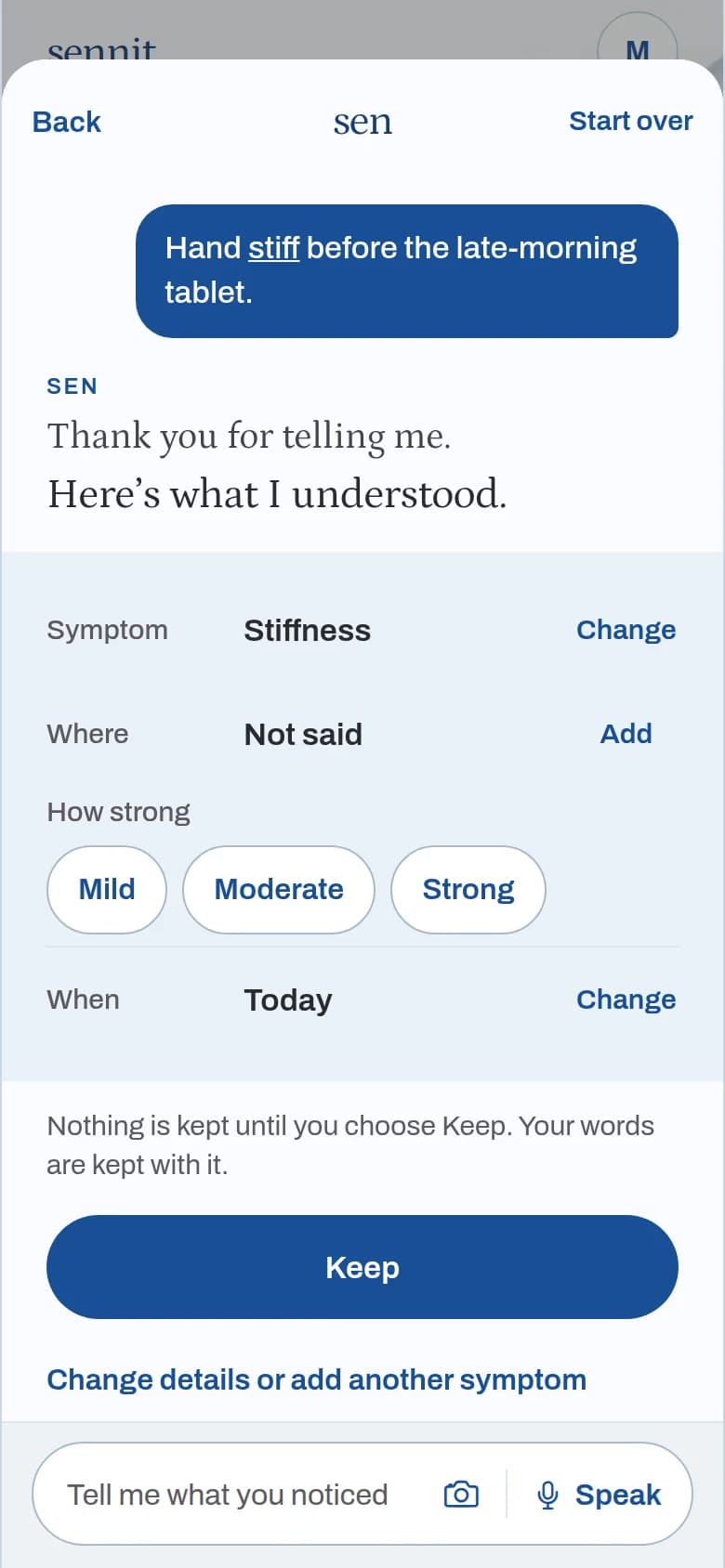
Sen shows what it understood. Nothing is kept until they say so.
Kept with its source
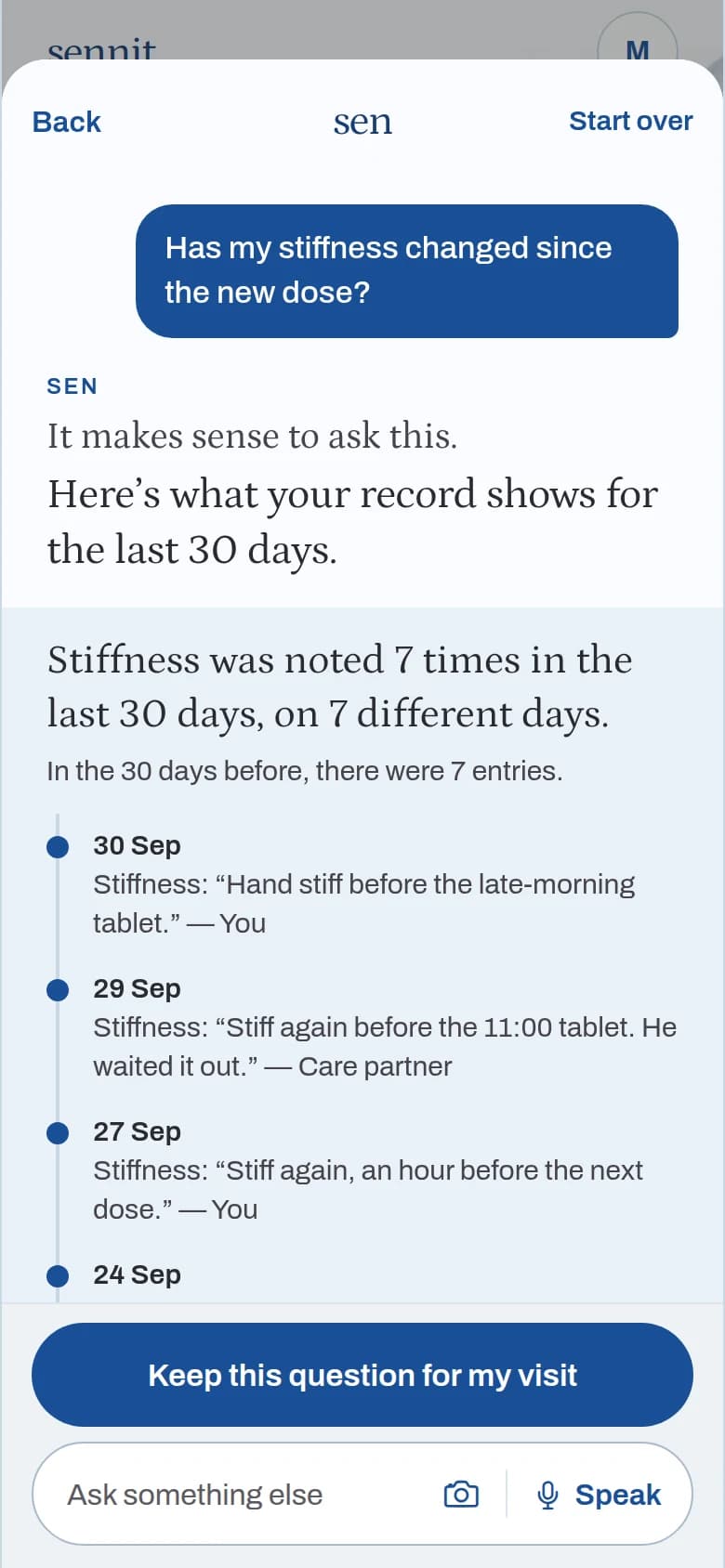
Who noticed it, when it happened and when it was written down stay with the entry.
Shown with its limits
Answers cite their entries and say what the record cannot see.
“Stiff again before the 11:00 tablet.” Noticed by Sophie
Models can help with the first two steps. They never decide what is kept or who sees it.
Who owns what
Models are useful for language. Rules are better for authority. Sennit keeps the two apart.
Rules own
- Permissions and privacy
- What Today shows, and when
- Saving, correcting and sharing
- A full history of every change
Models may assist with
- Turning speech or text into a draft to check
- Explaining the record, citing its entries
Models never own
- Diagnosis, prognosis or urgency
- Medicine changes
- Saving, sending or notifying
- Disease-stage or capacity judgements
A model can create a draft. Only a person can make it part of the record.
Simple on the screen, deliberate underneath
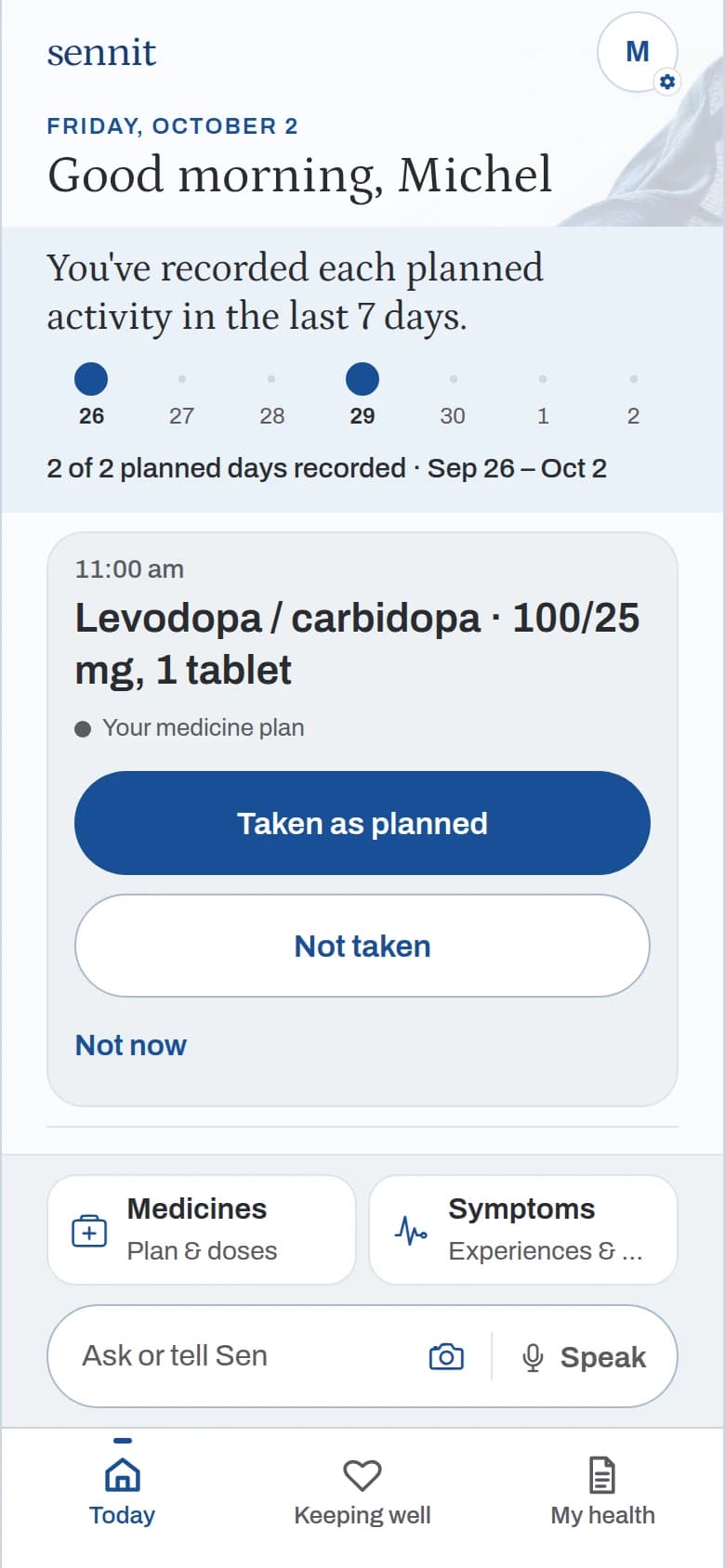
Each screen offers one main action, large controls for hands that shake, and plain language. Sen shows what it understood inside the person’s own sentence before anything is saved. The interface can become simpler when a person chooses it, and it can always be reversed. It never adapts because of symptoms, missed doses, diagnosis or inferred decline.
Screens from the Sennit app, example data.
Rated properties
A braided cord ships with a specification. So does the Sennit record: what it does on a hard day.
| Property | Rating |
|---|---|
| Entries overwritten by a correctionIn development | None. A new version is added. |
| A day with nothing recorded | Unknown. Never counted as missed. |
| Accounts from different people | Kept separately, each with its source. |
| Disagreement between accounts | Kept. Not resolved by Sennit. |
| A dose taken late | Filed against its planned time, with the actual time beside it. |
| Who can see an entry | Checked in one place, every time the record is read. |
| Comparison basis | The person’s own history. No population norms. |
| Diagnoses, stages, scores | None issued. |
| Medicine changes made by Sennit | None. |
| Answer when the record is too thin | Says what is missing. |
| Saved without the person’s confirmation | Nothing. |
| Urgent alerts | None. Sennit is not for emergencies. |
Each rating is a behaviour we test with example households. Ratings marked In development are designed and not yet in the app.
What is built, and what is next
The structured care record, privacy checked in one place, the rules that choose what Today shows, record answers that cite their entries, and visit briefs linked to their sources. Tested with example households.
Moving every part of the app onto the new record, which runs alongside the current one and is checked against it before the switch. Voice transcription, with review before anything is kept.
Reading documents into drafts to check, more languages, and careful testing with clinicians and families. The detail is in our technical brief.
Early testing uses example records, not people’s own health information. Before real data is used, we will publish how it is stored, who can access it and how models process it.
We want to hear from engineers, data and AI practitioners and partners who care about getting health data right.